


Director of the Taiwan Studies Initiative at IU Bloomington
Since its establishment in 2018, the Taiwan Studies Initiative (TSI) at Indiana University Bloomington’s East Asian Studies Center has become one of the most dynamic platforms for Taiwan-related teaching, research, and public engagement in the American Midwest. Led by Associate Professor Wang Fei-Hsien, the initiative has sought not only to expand understanding of Taiwan across academic disciplines, but also to create meaningful connections between the university, the Bloomington community, and institutions in Taiwan.
Supported in part by Taiwan’s Ministry of Education through the Taipei Economic and Cultural Office in Chicago, the initiative hosts a wide range of regular activities, including two Taiwan-focused academic talks each semester, an annual “Taiwan Day” event, and numerous collaborative projects that explore Taiwan’s history, society, politics, and culture. Teaching has also been a key pillar of the program. Two Taiwan-related courses, “Taiwan in Global History” and “Taiwanese Culture and Society Through Film,” are offered each year and have consistently attracted students from a broad range of disciplines across the university. Looking ahead, the initiative hopes to establish a dedicated Taiwan Studies minor within the next three years, further strengthening Taiwan-focused opportunities at Indiana University.
One of the initiative’s greatest successes has been its ability to bring together scholars from across Indiana University’s diverse academic landscape, creating opportunities for interdisciplinary dialogue that extend well beyond traditional academic boundaries. Through partnerships spanning the humanities, social sciences, arts, and language education, Taiwan has become a focal point for broader conversations about democracy, identity, culture, and global engagement.
A particularly innovative example of this approach is an ambitious music project that connected visiting Taiwan scholars with students from the university’s music program. Selected music students attended the talks from the visiting scholars, interviewed them about their research, and were then tasked with composing original pieces inspired by the themes and ideas they encountered. The project culminated in special performances at the university’s performing arts center, demonstrating how Taiwan Studies can inspire creative engagement far beyond the classroom.
Indiana University Bloomington has also developed a strong partnership with National Taiwan University (NTU) through the Huayu BEST (Bilingual Exchanges of Selected Talent) program. Since 2021, this collaboration has strengthened Mandarin-language education at Indiana University while creating new opportunities for student exchanges, scholarships, visiting instructors, and cultural programming. The partnership has also enabled students to study in Taiwan and gain first-hand experience of Taiwanese society and culture through direct engagement.
What truly distinguishes the Taiwan Studies Initiative at Bloomington is the creativity with which its programs are developed and the extent to which students are involved in shaping them. Professor Wang noted that Taiwan Day, one of the initiative’s major annual events, could quickly become repetitive if it were organized solely by staff each year. Instead, students are encouraged to take an active role in designing themes, activities, and new ideas, ensuring that each year’s program remains fresh and engaging.
This approach has produced a number of memorable events. One example was the “Cycle Around Taiwan” challenge, organized in collaboration with the local transportation authority. Participants were encouraged to cycle between stations across Bloomington, each representing a different location in Taiwan. At each station they could learn about the featured destinations and collect themed souvenirs connected to each site. This year’s Taiwan Day evolved into an entire “Milk Tea Month,” featuring activities ranging from bubble tea DIY workshops to academic talks exploring the history of Taiwanese tea and even the “Milk Tea Alliance!” Unsurprisingly, Taiwan Day has become one of the flagship events of the initiative and a major point of engagement for both the university and the wider Bloomington community since its launch in 2018.
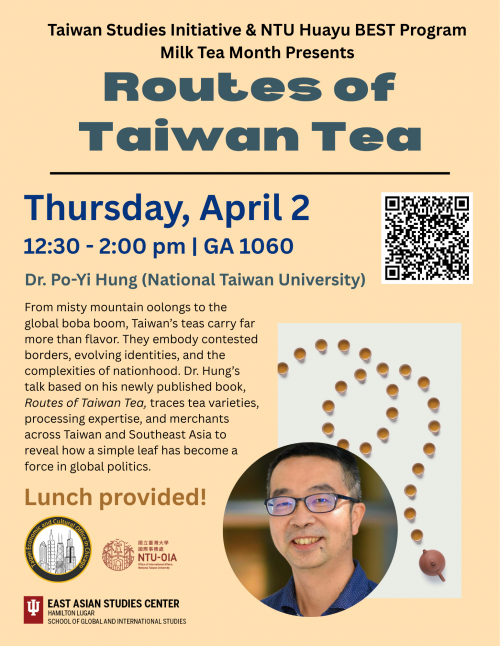
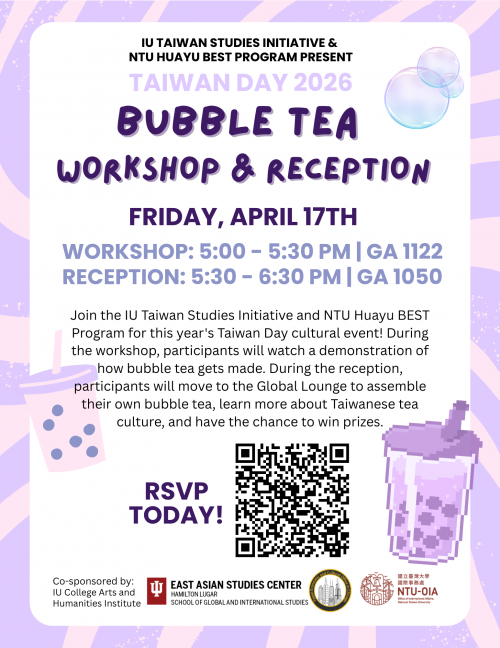

More broadly, lecture series, book talks, visiting scholars, and research workshops have introduced students and faculty to leading voices in Taiwan Studies. Initiatives such as the North American Taiwan Studies Online Summer School and the IU–Taiwan Collaborations in Music Project further demonstrate the program’s commitment to innovative and interdisciplinary forms of exchange. In this vein, the Taiwan Studies Initiative is even hosting this year’s North American Taiwan Studies Association Annual Conference, to be held June 26-28, 2026 (see more info here).
Ultimately, creativity has been the key ingredient behind the Taiwan Studies Initiative’s impact. Despite operating on a relatively modest scale, it has demonstrated how imagination, collaboration, and student engagement can significantly expand the reach and impact of Taiwan Studies. Professor Wang’s advice to colleagues around the world is not to wait until substantial funding becomes available before pursuing ambitious goals. Instead, institutions should make creative use of the resources already at their disposal to build connections with departments beyond traditional Taiwan-focused fields and encourage students to play an active role in shaping programs and events. In doing so, something more meaningful than the exchange of information takes place. A transfer of enthusiasm and curiosity occurs, creating unexpected opportunities for collaboration, inspiring future research, and ensuring that Taiwan Studies continues to grow in new and exciting directions.
Reporting by Joshua Edbrooke