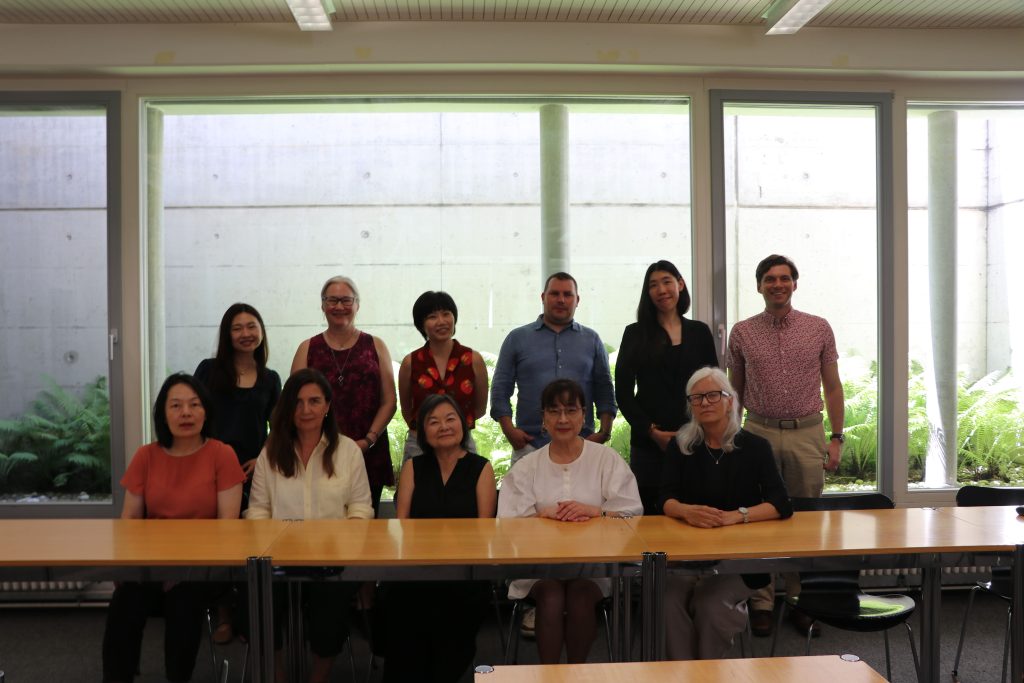

On 17–19 June 2026, the University of Bern hosted the international workshop “Taiwanese Literature as Planetary Literature: Reframing World Literature.” Supported by the Swiss National Science Foundation and the International Taiwan Studies Center at National Taiwan Normal University, the workshop brought together scholars from Europe, North America, and Asia to explore how Taiwanese literature can contribute to contemporary debates in world literature, comparative literature, Sinophone studies, and the environmental humanities.
The workshop was organized around a central question: how might Taiwan serve as a vantage point from which to rethink the concept of world literature itself? While world literature has traditionally focused on the circulation of texts across national and linguistic boundaries, participants considered whether the framework of planetarity offers new ways of understanding literary relations in an era marked by ecological crisis, geopolitical tension, migration, and queer expression.
Over the course of three days, speakers examined Nishikawa Mitsuru’s writings on colonial Taiwan (Faye Yuan Kleeman), Yang Shuang-zi’s reimagining of colonial history (Wen-chi Li), Nieh Hualing’s transnational literary networks (Mung Ting Chung), and Sanmao’s travel writing and global mobility (Luisa Shu-Ying Chang). Other papers focused on the poetics of Chen Yuhong (Cosima Bruno), the speculative imagination of Chang Hsi-kuo’s science fiction (Michael O’Krent), and representations of movement, displacement, and border-crossing in the works of Lee Yung-ping and Li Zishu (Alison Groppe). The workshop also featured discussions of Indigenous ecological thought in the writings of Syaman Rapongan (Wendy Wang), environmental consciousness in the works of Wu Ming-yi (Gwennaël Gaffric), and queer forms of belonging and relationality in the writings of Li Kotomi and Kevin Chen (Pei-yin Lin and Sophia Chen).
A recurring theme throughout the workshop was Taiwan’s position at the intersection of multiple historical and geopolitical forces. Participants explored how Taiwan’s experiences of colonialism, Cold War division, democratization, linguistic diversity, and cultural hybridity generate distinctive perspectives on planetary interconnectedness. Rather than treating Taiwan as peripheral to global literary developments, the workshop highlighted Taiwan’s potential to illuminate broader questions concerning coexistence, relationality, and the uneven distribution of power in the contemporary world.
The workshop concluded with a roundtable discussion on future directions for research. Building on the themes explored throughout the event, participants reflected on the possibility of imagining Taiwan not simply as a fixed geographical entity but as a tectonic plate moving toward planetarity. This metaphor highlighted Taiwan’s capacity to generate new forms of connection across linguistic, cultural, and geopolitical boundaries while remaining attentive to historical difference and local specificity.“Taiwanese Literature as Planetary Literature: Reframing World Literature” demonstrated the richness of Taiwan literary studies and its potential to reshape broader conversations about literature, culture, and the planet.
Guest reporting by Lee Wen-chi (利文祺)