

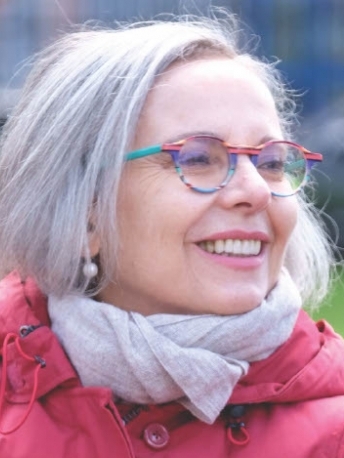
When Taiwan Studies first emerged at Roma Tre University in 2012, Taiwan was still largely absent from Italian university curricula. Courses in Chinese literature tended to focus on China, leaving limited space for Taiwan’s distinctive historical and cultural experience. Against this backdrop, Professor Rosa Lombardi began developing a program of activities designed to introduce students (and the wider public) to Taiwan through a broad range of cultural and academic perspectives. Rather than beginning with a formal degree program, the initiative grew through lectures, workshops, film screenings, and meetings with Taiwanese writers, scholars, and artists, encompassing literature, cinema, theatre and calligraphy. The enthusiastic response provided an early indication that there was both genuine interest among the student population and a strong foundation on which to build.
A central feature of Roma Tre’s approach has been its emphasis on active student participation. Students have been encouraged to move beyond just attending events and instead take part in projects such as the translating and subtitling of Taiwanese films, as well as introducing authors and literary works themselves, helping to build a sense of ownership, which also gives motivation to students to help promote the events themselves. This student-centered model has helped transform initial curiosity into sustained academic interest and has spilled over into the classroom, with students beginning to write BA and MA theses on Taiwan literature. In fact, an academic pathway has begun to open, with both doctoral and postdoctoral research being undertaken on topics centered around Taiwan.
This development has given the Taiwan Studies Center at Roma Tre a distinctive identity within the European field. While its work has expanded into areas including society, politics, technology, artificial intelligence, and international relations, culture remains its foundation. Literature, history, and cinema provide the starting points for an interdisciplinary understanding of contemporary Taiwan, while translation serves as an important bridge between Taiwan and Italian audiences. The Center has also seen success in extending Taiwan Studies beyond the university through publications, public events, and film screenings that reach the wider Italian society.
Among the Center’s highlights has been the 2019 international workshop Sinophone Literature from the 19th Century to the Contemporary Ages, organized as part of the Spotlight Taiwan project sponsored by Taiwan’s Ministry of Culture. The workshop brought together young scholars from around the world, including Taiwanese PhD candidates and researchers working on subjects ranging from Indigenous literature and poetry to political fiction and leftist writing. Beyond providing an academic forum, the event helped establish lasting connections between participants.
Another major initiative was Macrocosmo Taiwan, a three-year project running from 2021 to 2023 that used audiovisual translation and subtitling as an innovative way of introducing Taiwanese literature and culture to students. Under academic supervision, students translated and subtitled 14 films from the Taiwanese series Yuedu Shiguang《閱讀時光》, as well as two documentaries, before preparing presentations and introducing the films to live audiences. The project demonstrated the value of combining academic study with audiovisual forms that resonate strongly with students, while giving them a direct and practical role in engaging with Taiwanese literature, culture, and history.
The Center has also brought a diverse range of Taiwanese voices to Roma Tre. Lectures and discussions with writers and scholars including Chen Li, Wu Yi-wei, Syaman Rapongan, Professor Su Shuo-bin, and David Der-wei Wang have exposed students and audiences to different dimensions of Taiwan’s literary and cultural landscape. Syaman Rapongan’s presentation on Tao culture and Indigenous and oceanic literature, which also included a personal performance of a Tao song, was particularly memorable. Chen Li’s poetry sessions have also had a lasting impact, with several students subsequently choosing to write their theses on his literary work.
Looking ahead, Roma Tre is seeking to consolidate this foundation through stronger institutional partnerships and an expanding programme of student-focused activities. The Center has collaborated with Fu Jen Catholic University for student exchanges and is developing further collaborations with Taiwanese institutions in Taipei and Tainan. The Center has an important role bringing an Italian voice into the European Taiwan Studies community, which it does through connections with EATS, as well as its own strong connections with the Chair in Taiwan Studies at INALCO in Paris and the Centre of Taiwan Studies at SOAS. It will also actively participate in the upcoming forum on Taiwan Studies in Southern Europe.
The next five years are set to bring an even greater emphasis on developing the next generation of Taiwan scholars from Italy. Planned activities include new curricular modules, literary workshops on Taiwanese women’s fiction and poetry, experimental visual poetry, audiovisual translation, film screenings, tea tasting, calligraphy, traditional fan and umbrella painting, and a podcast on Taiwanese culture. Perhaps most importantly, the Center has established four research grants for undergraduate, master’s, and PhD students to undertake research in Taiwan. It has also awarded funding for an annual postdoctoral research grant and a three-year PhD scholarship in Taiwanese literature. Together, these initiatives reflect Roma Tre’s ambition to move from creating interest in Taiwan to developing a sustainable community of researchers capable of carrying Taiwan Studies forward in Italy and beyond.