

Intro
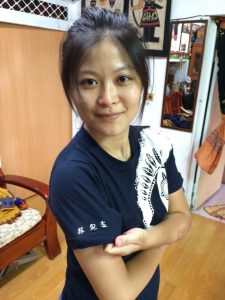
Lin Wan-Jou (林宛柔) is a PhD student at NTNU’s Department of Taiwan Culture, Language and Literature. In this interview, she discusses the two main approaches that she incorporated into her dissertation. First, she conducted textual analysis of Liglav A-wu’s literary works, complemented by interviews with the author to better understand her narrative strategies and intellectual positioning. Second, she employed an ethnographic approach in the Ciulaku community in southern Pingtung, focusing on lived experiences, forced displacement, and local knowledge production. Together, these two methods allowed her to place literary analysis and community-based research in dialogue with one another.
LW: Lin Wan-Jou
JY: Jessica Siu-yin Yeung
JY: Could you please briefly introduce yourself first?
LW: I am Lin Wan-Jou from Pingtung and I am a PhD student at National Taiwan Normal University. My dissertation is titled “A Decolonial Critique of Ecofeminism on Indigenous Knowledge.”
JY: I read that you studied English literature, including the modernist literature of Radclyffe Hall, during your master’s program. Can you share why you changed your field from English literature to Taiwan Indigenous literature, and women’s writings in particular?
LW: I did my master’s training because I’m interested in literature. My master’s thesis focused on gender, while my studies then gave me different perspectives and enabled me to appreciate literature. At the same time, I participated in many activities organised by Presbyterian churches. Presbyterian churches played a very important role in Taiwan’s democratization. As an English-language speaker, my role was to introduce Taiwan to international guests, such as those from Canada. I was a bit lost then, as I wasn’t sure what to present, as I didn’t know Taiwan well enough to do my job.
We have many Indigenous churches, and I have close relationships with friends from them. During my job of introducing Taiwan to these international guests, I learned a lot about the complicated contexts of the Indigenous peoples in Taiwan. Hence, I decided to continue this journey in academia and turn my focus to my homeland, with a focus on Indigenous women.
JY: Your doctoral research seems pretty interdisciplinary. It straddles literary studies and social sciences such as anthropology and geography. In what fields would you like to situate your contributions?
LW: I’d say cultural studies or sociology. Researchers from these fields may be more likely to understand my approach.
I’d also like to explain why I adopt such an interdisciplinary approach — my master’s training equipped me with the skills to do textual analysis in literature. Besides reading Indigenous literature to better understand its contexts, my dissertation is also informed by their movement, a call for a “return to the community” (回歸部落), which argues that the Indigenous movement should be grounded locally, rooted in everyday life, and responsive to the concrete needs of Indigenous communities. In the 1980s, a generation of elites in the Indigenous movement pioneered a dialogue with mainstream society in Taiwan about their oppression. They also led the “return to the community.” Rather than speaking abstractly on behalf of Indigenous peoples from urban or institutional spaces, they insisted that advocacy must emerge from direct engagement with community experiences. In their view, the movement should take root in the land, begin from the needs of the community, and truly understand people’s lived realities. I understand the importance of this lived experience in their communities and therefore decided to incorporate this context into my analysis of both ethnographic research in Ciulaku and the Indigenous literary works of Liglav A-wu examined in my project.
JY: I think in cultural studies, this is called an intersectional approach.
As a speaker of Paiwanese at an elementary level and Taiwanese Taigi at an intermediate (B1) level, to what extent do you think these language proficiencies help with your project?
LW: This issue is part of my project — when we say “Indigenous literature,” we mean “Indigenous Mandarin-Chinese literature.” The period that my project focuses on begins in the 1980s. Back then, the writers wrote in Mandarin Chinese …
JY: Like Syaman Rapongan (夏曼·藍波安) …
LW: Yes. They tried to converse with the mainstream Han society, saying “we’re oppressed by you, the state policy, and the assimilation of it in the postcolonial society.” Referring back to the aforementioned movement in which these Indigenous writers returned to their communities, some of them began writing about their own Indigenous languages. Hence, although they wrote in Mandarin Chinese, we can see that their narratives were expressed through an interlanguage between their own languages and Mandarin Chinese, making their literary works distinct from mainstream Taiwan literature.
I adopted an ethnographic approach to understand forced displacement in the Ciulaku community on the Hengchun Peninsula in southern Taiwan. They knew I was Han and they spoke Tâi-gí (Taiwanese language) to me (laughs). I was very surprised because they spoke very good Tâi-gí. But then, when they indicated some geographical locations, they used their own languages and I didn’t understand. I had to ask the younger generations for clarification. I was surprised that they adapted to my mother tongue so well, but I couldn’t speak their languages in return.
JY: That’s very enlightening.
If you had to articulate the contributions of your PhD project, how would you put it?
LW: As a Han settler, it’s important to me ethically that I’m not trying to speak for them. I try to decolonize both Western ecofeminism and Han feminism. I’ve seen their struggles and I’d like to stand with them. My project is underpinned by my conviction that we, as a Taiwanese society, still have work to do in decolonization and that we’re yet to enter the postcolonial period.
JY: What does “decolonizing Taiwan Studies” mean to you?
LW: There are two strands in the context of my project regarding decolonization. First, I’ve seen their struggles and my project shows that they have agency and resilience. Second, as a Han settler, the critique goes back to my community. For instance, in Han feminism, we often criticize men. But we can’t do this to the Indigenous community because Indigenous men also suffer, as indicated by their early deaths in demographic data.
I think, as Han settlers, with regard to the Indigenous issues, we often remain silent and give them space to speak for themselves. I also think that standing with them and adopting strategies to express our solidarity and show that we understand their struggles are equally important. We both belong to the same community, living in Taiwan.
So decolonizing Taiwan Studies, to me, represents a critique of the mainstream settler community.
JY: Lastly, would you have any advice for Taiwanese or foreign researchers doing Taiwan Studies?
LW: I think, from my experience, do what you’re interested in and it’ll bring you new insights. I also think that Taiwan will enhance the theoretical approach one adopts by contributing unique examples of its own.