

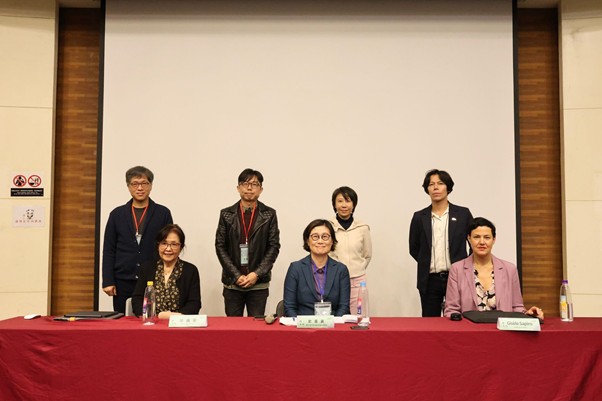
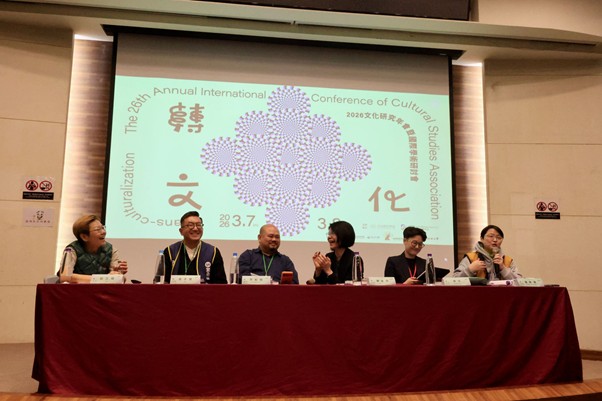
Over the weekend of March 7-8, the Cultural Studies Association (文化研究學會) held its 26th Annual International Conference at NTNU, with the International Taiwan Studies Center serving as a co-organizer. This year’s conference was centered on two concepts: “trans,” referring to not just crossing but also the energy of dynamic changes, transitions, and regeneration; and “culturalization,” which emphasized that the concepts and practices which make up culture are not goals in and of themselves, but means and processes which are continually reshaped, recoded, hybridized, and intervened in. Together, these made up the conference’s theme of “Trans-culturalization.”
Over 360 scholars from eleven different countries were in attendance as speakers, discussants, presenters, reviewers, moderators, and audience members. 186 papers covering an enormous variety of topics were presented across the two days of the conference, along with three keynote speeches and three roundtable discussions.
The opening keynote address was delivered by Gisèle Sapiro, Professor of Sociology at the School for Advanced Studies in the Social Sciences (École des hautes études en sciences sociales, EHESS) in France. She is also the author of La sociologie de la littérature (The Sociology of Literature), a highly influential volume that builds on the work of renowned theorist Pierre Bourdieu to analyze the creation, definition, and circulation of literature. The Mandarin edition of the book, translated by Professors Su Shuo-bin (蘇碩斌) and Liu Chan-yueh (劉展岳), was published earlier this year.
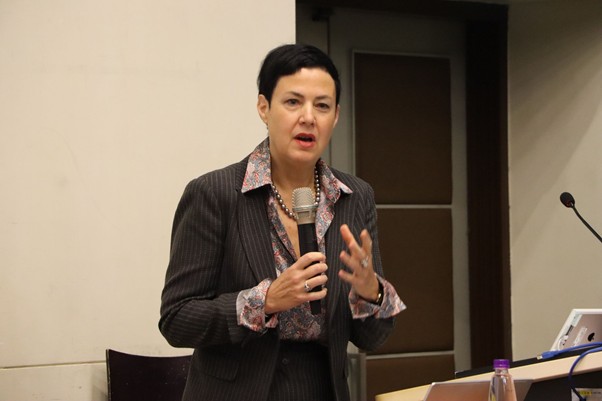
Professor Sapiro’s address discussed the asymmetries of literary translation and circulation, and how the center-periphery structure of the global book market parallels linguistic center-periphery structures. She noted that although the situation has seen gradual improvement, the circulation of works written by peripheries still relies on mediation by linguistic and cultural centers, while the market as a whole remains dominated by the English language and large publishers. This means that even though recent years have seen greater focus on postcolonial and female authors, other literature from the periphery still faces significant difficulties in being translated, bought, and read in centers.
The keynote address was followed by the first roundtable of the conference, “T(h)reading Transnationally: From Film and Feminism to Music and Theatre,” which discussed how culture and products associated with cinema, feminism, indie music, and drama are creating an international network by “treading, threading, traveling, traversing, transporting, transacting” across national borders.
The second day saw the second keynote address: “East Asian Popular Culture in the Age of ‘Techno-Feudalism’: Cultural Studies in the Post-Media Era,” by Mōri Yoshitaka (毛利嘉孝), Dean and Professor of the Graduate School of Global Arts at Tokyo University of the Arts. The speech examined how “platform capitalism” is turning modern corporations into national vassals with users as labor-producing serfs, and how this affects the flow of popular culture. East Asian popular culture, in turn, is transforming itself outside of the mainstream to resist these changes.
The third keynote speech, “Dancing with the Language Monster: A Cultural Researcher’s Daily Conversations and Story Co-creation with GPT,” by Professor Michelle Huang (宗儀老) of the Department of Geography at National Taiwan University, reflected on her long-term interactions with AI, noting the presuppositions that underlie debates about the utility, subjectivity, and possible consciousness of AI, and proposing a cautious but open approach to its study and use.
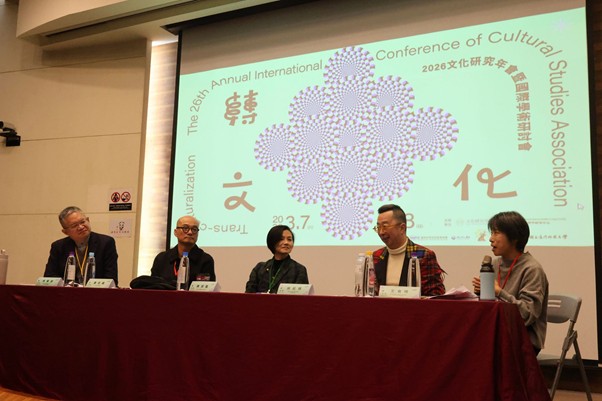
The conference ended with a pair of roundtables. The first featured Professor Howard Chiang (姜學豪), Associate Research Fellow Liu Wen (劉文), Associate Professor Lee Po-han (李柏翰), and Professor Li Shu-chun (李淑君) discussing “Queer Taiwan in the World: A Cross-Disciplinary Dialogue,” moderated by Distinguished Professor Wang Hsiao-yong (王孝勇). With backgrounds in four different areas, the scholars positioned Taiwan’s gender studies relative to global gender discourse, reassessing its regional and global role, examining its blind spots, and exploring future research possibilities.
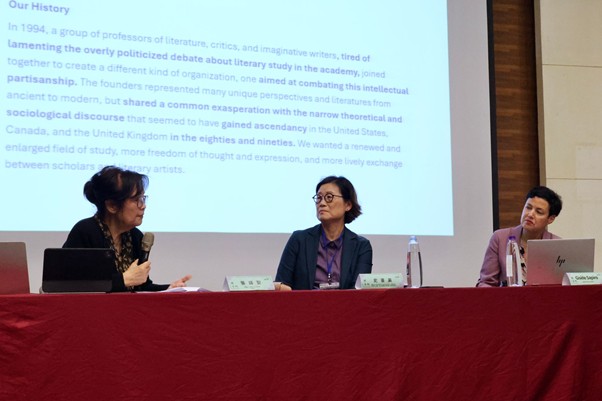
The final roundtable featured Yvonne Sung-sheng Chang (張誦聖), Professor and Director of the Center for Taiwan Studies at UT Austin, in conversation with Gisèle Sapiro, moderated by Irvine and Jean Stone Professor of Humanities at UCLA and prominent Taiwan theorist Shih Shu-mei (史書美). The talk covered their individual backgrounds and how they became literary sociologists, before moving on to the uses of field theory and whether it has been accepted in academia. They also discussed the impact of postcolonial thought when it entered Taiwan and the fields of sociology and world literature, and attempted to answer whether, in the new bipolar world, new theories have significantly helped highlight literature from global peripheries. Although the discussion focused on the flow of literature in particular, the trends noted there reflect wider social phenomena and are applicable to fields beyond literature.
Overall, the conference was a solid success, and the wide variety of papers around the theme of “Trans-culturalization” enabled free cross-pollination of ideas across fields. The connections made at the conference are sure to further enrich the work being done in Taiwan Studies and strengthen the discursive power of Taiwan culture.
Reporting by Gregory Laslo (樓克己)