

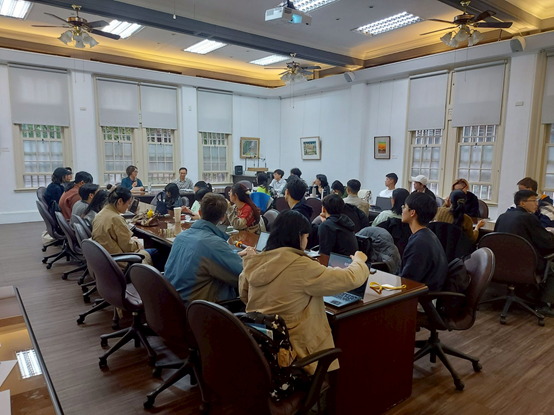
This December, Yushan Scholar and UCLA Irving and Jean Stone Professor Shih Shu-mei (史書美) hosted her second series of lectures on Taiwan theory, titled “Taiwan and Sinophone Studies across Disciplines” (跨學科的台灣與華語語系研究演講系列). The second lecture, held on Friday, December 5, saw perhaps the most distinguished speaker yet: Professor Howard Chiang (姜學豪), head of the Center for Taiwan Studies at UC Santa Barbara, and holder of the Lai Ho & Wu Cho-liu Endowed Chair in Taiwan Studies.
The author of two award-winning monographs (After Eunuchs: Science, Medicine, and the Transformation of Sex in Modern China and Transtopia in the Sinophone Pacific), Professor Chiang is a leading theorist in the field of queer Sinophone studies. His lecture at NTNU explored possible future directions of queer Sinophone studies in Taiwan through a discussion based off of two chapters from his upcoming book, Trans Without Borders: Decolonial Histories and the Epistemology of Taiwan. The two segments discussed the the potential of the adju (阿督) movement in queer Sinophone studies, and how queer studies can help to democratize the history of Taiwan–in this case, the history of unseen gender and sexual nonconforming people in Taiwan.
Professor Chiang argued that the adju (阿督) movement opens up new theoretical territory for both Indigenous and queer studies: queer Taiwan studies tends to focus on the Han queer experience, while Indigenous Taiwan Studies tends to ignore gender nonconformity and heteronormative pressures, but the study of adju involves both. The word adju comes from the Paiwan language and was originally used as a friendly form of address between women. With a political capacity similar to the North American Indigenous “Two-Spirit” concept, it was later used to refer to feminine-presenting or queer males, and it is now used in this way across many Indigenous groups in Taiwan. Because its usage is locally-grown and distinct from both Western medicalized transgender concepts and Han Chinese labels like tongzhi (同志) and niangniangqiang (娘娘腔), it offers space to resist assimilation by either.
The second half of Professor Chiang’s lecture focused on how the methodology of queer Sinophone studies can offer a more democratic, locally-grounded history of Taiwan, in particular regarding the unseen queer community in Taiwan through their representation in 20th century news reports. He applied two approaches: queering periodization and cultural creolization.
Taiwan’s history is traditionally periodized according to which outsiders were in power. But queering periodization–focusing on local, personal queer experience–instead yields turning points between historical eras, and better centers identities, especially non-heteronormative ones.
Taking cultural creolization, meanwhile, as the conceptual baseline of Taiwan’s history allows scholars to escape the framework of nationalities, better understanding how “Taiwaneseness” arose and varied across different periods and cultural contexts, and reinforcing a human-centered, bottom-up methodology.
Professor Chiang concluded with a reminder that the global crisis facing democracies around the world is also a crisis for queer Sinophone studies; just as queer Sinophone studies argues for a more democratic worldview, repressive governments are reducing the space available for ethical dialogues.
The lecture was followed by a lively Q&A session, which dove deeper into the concept of periodization, as well as larger questions of linguistic variation and representation, such as whether the English “queer” is precisely the same as the Mandarin ku’er (酷兒).
The lecture’s emphasis on intersectionality and personal identity forecasts new ways of approaching not just queer Sinophone studies, but Taiwan Studies as well. We look forward to the refinement in research that these approaches will bring to the field and global perception of Taiwan.
This program is co-sponsored by the Yushan Program of the Ministry of Education and the Center for Taiwan Studies at UCSB.
Written by Gregory Laslo (樓克己)