

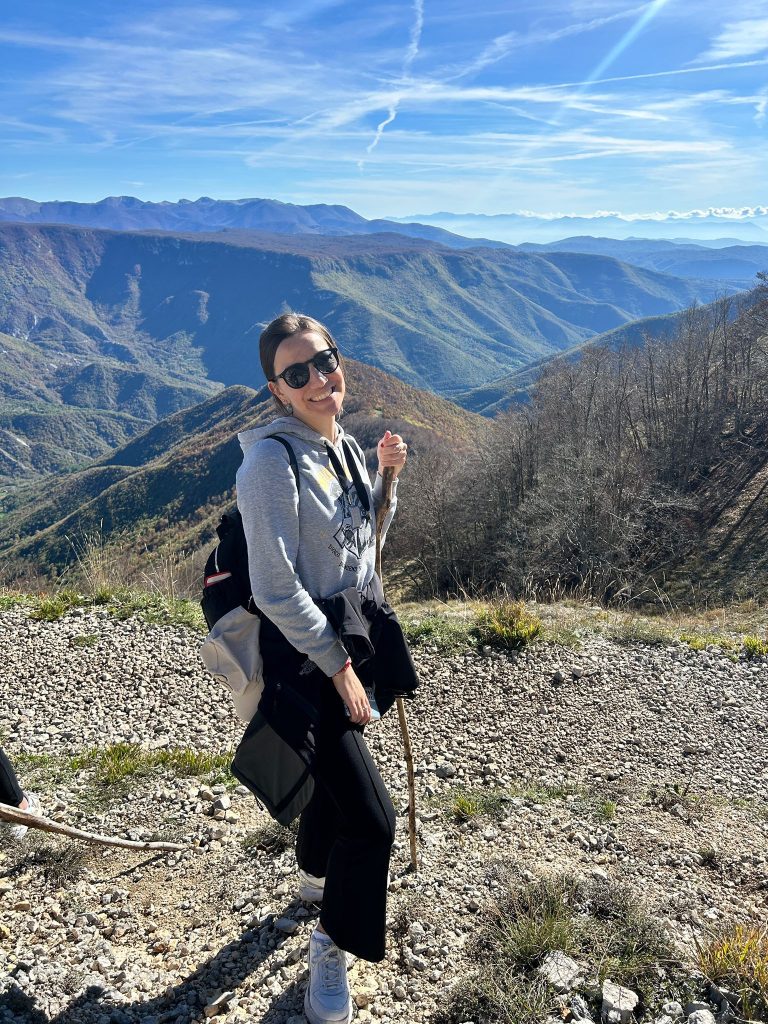
Silvia Schiavi is a Postdoctoral Research Fellow in Taiwan Literature at Roma Tre University, and also serves as Coordinator for the Roma Tre Taiwan Studies Project (2025-2030) and the Taiwan Studies Center. In our interview, she shares some of her latest research into female poetics from Taiwan and the challenges of conducting this research on Taiwan Studies while based in Italy.
SS: Silvia Schiavi
GL: Gregory Laslo
GL: Could you please introduce yourself? What is your area of scholarship, and what is your latest research about?
SS: My name is Silvia Schiavi, and I am a postdoctoral research fellow in Taiwan literature at Roma Tre University. I work on a variety of topics, but the common denominator is poetry, specifically Sinophone poetry from Taiwan.
After attending a translation workshop on Ling Yü (零雨) in 2024, the Taiwanese poet who won the Newman Prize for Chinese Literature in 2025, I became really interested in both her poetry and women’s poetry in general. Now, I’ve started investigating women’s poetry as part of a Roma Tre postdoctoral grant called “Gender Voices: Women’s Literature in Taiwan in the New Millennium.”
My aims in this project are to focus on the way women’s literature, and specifically poetry, is still engaged in exploring gendered limitations and patriarchal expectations of women’s roles, and how women artists and writers try to defy and critique these expectations. I’ve found a very striking example in Ling Yü’s latest collection, Daughters《女兒》. She wrote this book for her mother, who was ill and then passed away.
Besides commemorating her mother, Ling Yü also reflects on the position of daughters and women in general in contemporary Taiwanese society. I was really interested in this focus by a female poet. Now, I’m also broadening the scope of my investigation to include other female poets, whom I will also meet during this visit to Taiwan: Ling Yü, Yan Ai-lin (顏艾琳) and Pan Jiaxin (潘家欣), among others.
Another focus within this project is the metaphors, images, and symbolism found in women’s poetry, especially in Ling Yü’s work. What I want to hone in on is this metaphor of water, of the ocean, which comes to represent a refuge for women, while also being a symbol of liberation from the gendered expectations and the patriarchal oppression they feel.
And as we know, the ocean is also a metaphor for Taiwan’s “islandness.” This is something I want to investigate further to see if there is a relationship between these two points. I will give a talk about this in January 2027 for a panel organized as part of the 5th AEEAO International Congress at the Universitat Autònoma de Barcelona.
GL: As a researcher based in Italy, what challenges have you encountered in performing this research?
SS: Most of the difficulties I’ve run into have been related to the general situation Taiwan Studies is faced with in Italy. The curricula are largely focused on Chinese studies, and this has had knock-on effects on university library collections, which mainly collect Chinese studies books. So, for a long time, the only way for an Italian Taiwan Studies researcher to purchase books or papers and so on about Taiwan was to go to Taiwan directly or to buy them online. However, the situation has improved over the past ten years, and thanks to our newly established Taiwan Studies Center at Roma Tre, we now have an annual subscription to Airiti Library. It’s now much easier to find papers on topics related to Taiwan Studies.
The fact that Italian universities and Roma Tre have been focused on Chinese studies also means that we study simplified Chinese characters, so initially it was pretty challenging to read traditional Chinese characters. But eventually, I saw the importance of learning both traditional and simplified characters to better understand the Sinophone world. Because many scholars and writers use traditional characters, if you do not know them, you will miss a very important part of the scholarship.
Another thing is that in Italy, relatively few scholars specialize in or conduct research on Taiwan. So on the one hand, you have a huge responsibility to introduce Taiwan Studies in Italy, and on the other, in national conferences and events of similar scale, you may feel a little bit marginalized.
Lastly, another difficulty I’ve encountered is due to the fact that I mainly work on literature and poetry. It seems that there is currently a general trend among readers where literature is not very welcome, poetry even less so. In Italy it’s very difficult also to find publishers who are interested in publishing a book dealing with poetry or a book of literary translation.
GL: What initially brought you to the field of Taiwan Studies?
SS: I came to Taiwan Studies through my research into modernism, where I initially focused on the Shanghai modernists. But one of the leading figures in that area, the pioneer of Chinese modernists, was actually a Taiwanese writer, Liu Na’ou. It was my interest in his work which brought me to Taiwan for the first time to find the diary which he wrote in 1927. From this study on Chinese modernism, I moved to researching Taiwanese modernism in both the 1930s and 1950s for my PhD and my first postdoctoral grant.
I was inspired by the work of scholars such as Christopher Hill, who has published several studies on the development and travel of naturalism from Europe to East Asia. I wanted to see how the literary trend of modernism arrived and developed in both China and Taiwan. I was particularly interested in the agency of Taiwanese writers. They didn’t merely imitate or duplicate a foreign literary trend, but localized it, bringing in a lot of very specific topics, themes, and concerns, while also contributing to the global development of modernism.
GL: Looking to the future, where do you see your research taking you?
SS: For the time being, I think I will probably continue with this research on female poets and poetics. As I mentioned, I will be presenting on this topic at an upcoming conference in Barcelona. As part of my 2026-27 postdoctoral research grant, I will also publish an anthology of women’s writing, short fiction, and poetry, under the supervision of Professor Lombardi. But modernism was my first love in research, and I’m pretty sure that I will come back to it.
GL: What advice would you give to scholars who are new to Taiwan Studies?
SS: My first advice would be to go to Taiwan. In Taiwan, you can meet plenty of Taiwanese scholars who are more than happy to introduce not only their research topics but also Taiwan’s history and culture. Moreover, it’s really easy to conduct research in Taiwan. There are a lot of libraries available to you, including the National Central Library and many university libraries. The Ministry of Education also offers very generous scholarships to make study like this possible, so I think it’s worth giving it a try, especially for young scholars just entering the field of Taiwan Studies.
My second piece of advice would be to attend international conferences to share your research with others. If you focus only on your research and just share your findings or your research line with your immediate colleagues, you can find yourself marginalized. National-level conferences are stimulating, of course, but international conferences can help you to feel more connected with other scholars investigating the same things you are.
In some places, you’re not always encouraged to pursue Taiwan Studies, so going to international conferences is also a way to boost your creativity in your research and to find new avenues that you may have never thought of before.