

Early July saw Yushan Scholar and Irving and Jean Stone Chair Professor at UCLA Shih Shu-mei (史書美) return to Taiwan to host her latest series of lectures in the Taiwan and Sinophone Studies across Disciplines series. Speakers confronted questions of globalism, universalism, philosophy of technology, and the transmission of the local in intercultural contexts. The capstone event was “Made-in-Taiwan, Reassembled: Workshop on Technoscience and the Humanities in Global Circulation,” which took a Taiwan Studies approach to the historical intersection of technology and media culture, touching on music piracy, the gendering of AI assistant voices, depictions of robots in comics from Taiwan, and the KMT’s historical use of media diplomacy.
The first lecture, “Is Local Global? On Yang Shuang Zi’s Historical Yuri Novels,” by Director of the Chinese Studies Programme at Michigan State University Professor Sang Tze-lan (桑梓蘭), discussed Taiwan Travelogue, and delved into how its writing integrates and builds upon Taiwan’s long local traditions of historical yuri novels, postcolonial literature, poststructural metafiction, food literature, railway travel literature, and queer literature.
In light of the recent recognition given to Taiwan Travelogue, Professor Sang asked how the English translation expresses these traditions, and whether its recognition proves that these local traditions are what makes it globally appetizing. The book’s apparent emphasis on locality would suggest that this is what earned it recognition; but changes implemented in the English translation support the hypothesis that it is only because the book happens to align with supposedly universal, “global” values that the novel can be seen at all by Western audiences, which suggests the “global” of Taiwan Travelogue may only exist in Western literature circles. The question of whose worldview was threatened by the book was a main topic of the following Q&A, which also discussed the “glory of Taiwan” (台灣之光) cultural brand, the status of Taiwan Travelogue as postcolonial literature, and whether an author’s interpretation of their own work is always valid.
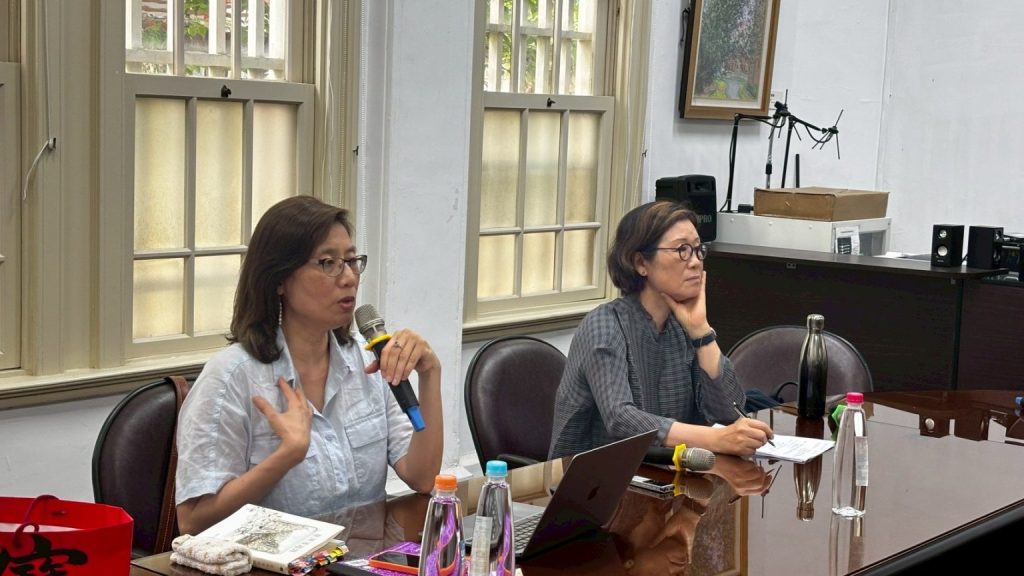
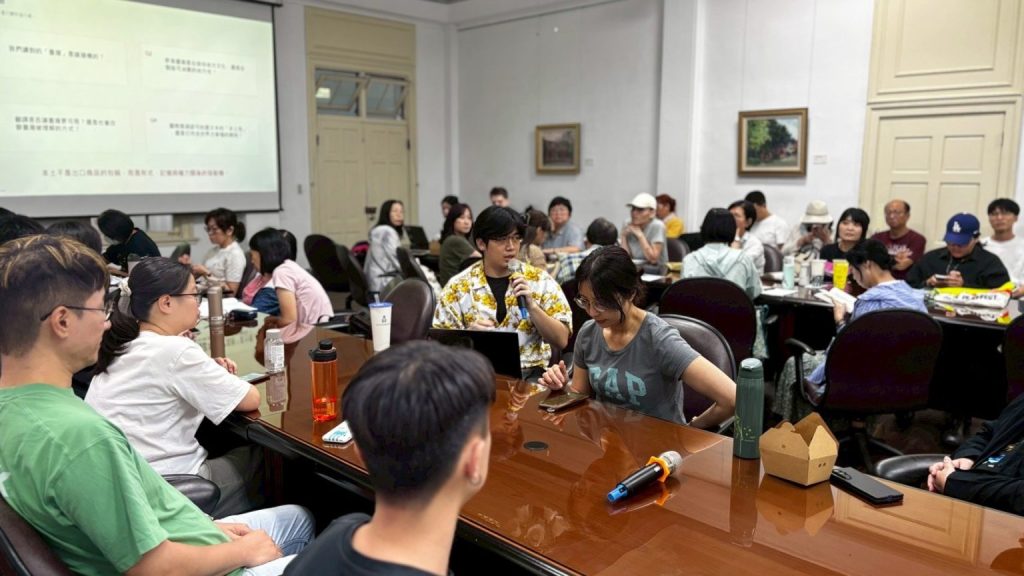
In “From the World to the Planetary, and Back Again: Rethinking Yuk Hui’s ‘Epistemological Diplomacy’ through Sinophone Epistemology,” Associate Professor Wu Chien-heng (吳建亨) of National Tsing Hua University analyzed the structure and capabilities of Yuk Hui’s (許煜) philosophy of cosmotechnics, and asked how it could mesh with Professor Shih Shu-mei’s theory of Sinophone studies. By “cosmotechnics,” Yuk Hui refers to the philosophies of technology created under the influence of complete global colonization by a strain of Western thought. He concluded that while Yuk Hui has modified Kantian ideas of conflict and “permanent peace” to better account for local perspectives and nuances, cosmotechnics might still not adequately address the practical role of international politics, and lacks the solid grounding in relational politics, and the critical platform to change them, which Sinophone studies does provide. However, listeners responded by acknowledging that universalist theories like Yuk Hui’s can help Taiwan theory gain more traction in the international academic community, and noted Yuk Hui’s possible influences.
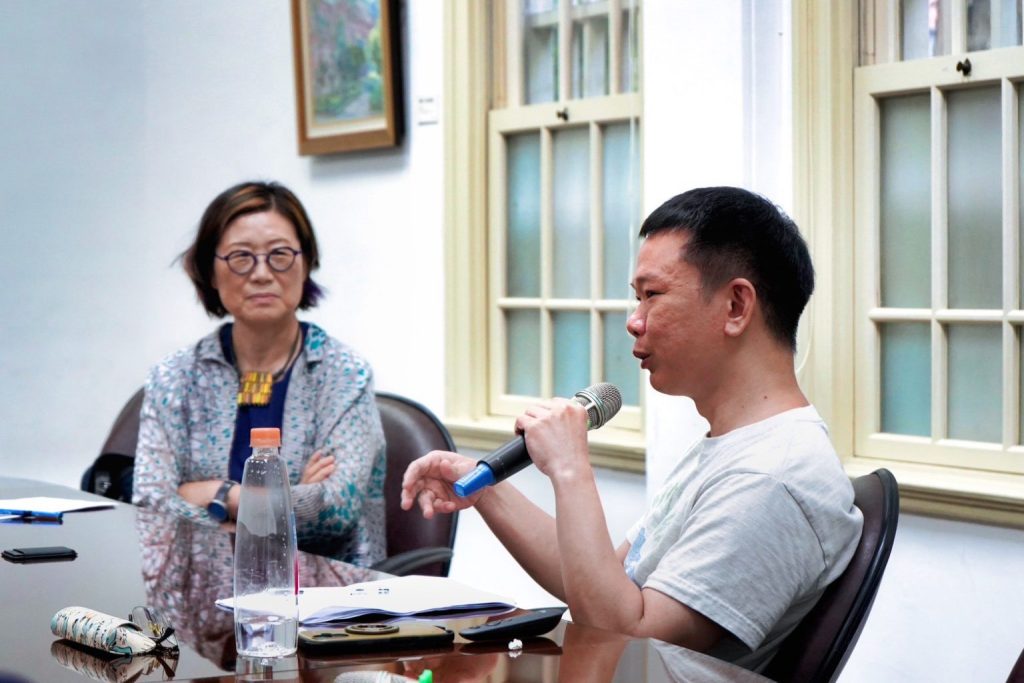
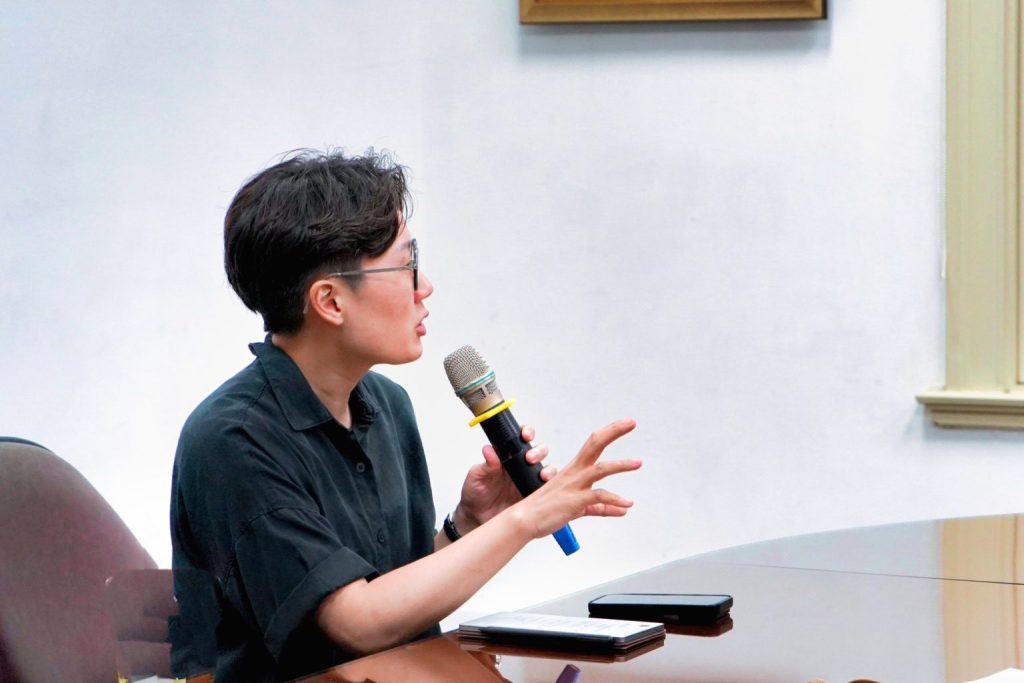
Associate Professor Simona Gallo, from the University of Milan, tested the ability of Sinophone studies to unsettle and remove the equivalence between nation, culture, ethnicity, language, and political belonging. In “Revisualizing Europe Through the Sinophone,” she presented a series of case studies of writers, poets, and playwrights such as Gao Xingjian, Qiu Miaojin, Yang Lian, Sanmao, and Yan Ge. The results confirmed that within Sinophone literary studies, Europe cannot be a monolithic pre-existing geography; actual unevenness within Europe aside, it is simply too big to fit in any given writer’s work. Writers therefore “descale” Europe to fit inside their works in ways that vary from writer to writer and over the course of their interaction with Europe – from imagination and conception, to perception, to living.
Given that Europe first “arrived” in Taiwan as vocabulary, not geography, Sinophone writers created it anew through their experiences and work, rather than reflecting an objective Europe. Sanmao shrank Europe down to the spaces and relationships within a Spanish family home; Yang Lian questioned how a location as often painted, photographed, narrated, consumed, and translated as Venice can be encountered. The variety of examples Professor Gallo presented triggered a discussion on the divergences between Sinophone-European and Asian American literature, and how different experiences of Europe have shaped the identities of those writing within it.
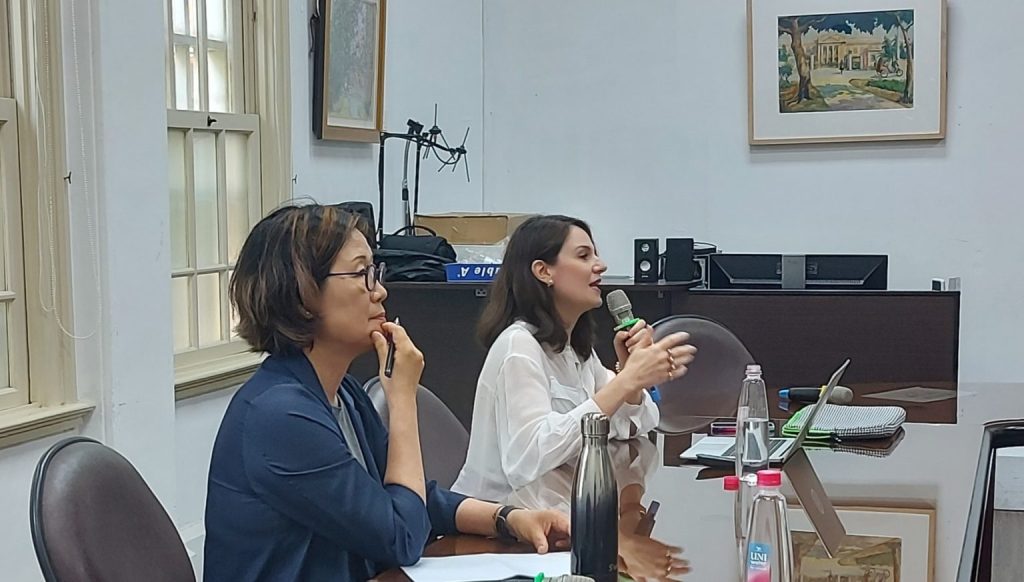
The final workshop panel, moderated by Professor Shih, was composed of NTNU postdoctoral fellow Raymond Kun-Xian Shen (沈昆賢), Assistant Professor Pei-chun Viola Hsieh (謝佩君) of NTNU, National Chung Cheng University Assistant Professor Hung Ching (洪靖), and Associate Professor Yu Chang-min (于昌民) of NTU. Titled “Made-in-Taiwan, Reassembled: Workshop on Technoscience and the Humanities in Global Circulation,” the workshop was an extension of themes developed at last year’s UCLA-NTNU Taiwan Studies Conference.
Raymond Kun Xian Shen began by presenting research on the interplay between the music industry and the culture of music piracy, discussing how new technology, lack of government regulation, and music piracy pushed record labels to improve and modernize throughout the 1980s-90s. Taking advantage of the accessibility of tape technology to offer services that record labels would not, piracy flourished in an era without strong enforcement of copyright law. This success forced record labels to redesign their marketing focus, adapting and refining the very services and strategies which attracted customers to piracy, including mix tapes and customization. In the process, record labels legally institutionalized some parts of music piracy culture.

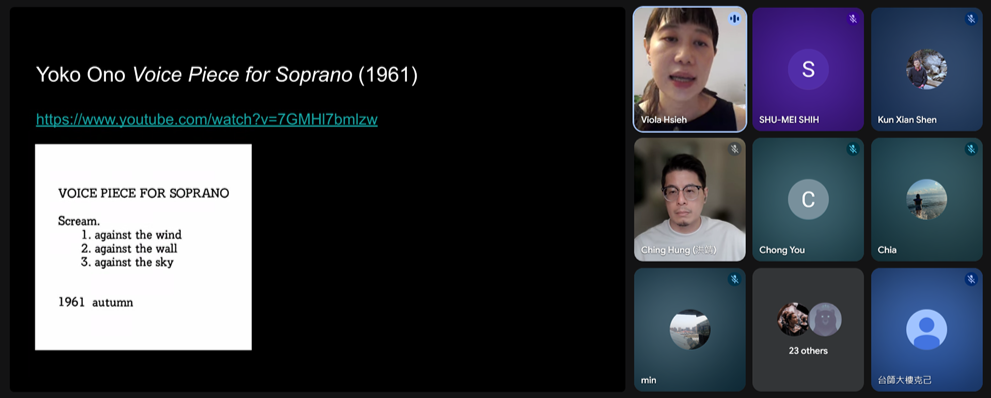
In her presentation, Assistant Professor Hsieh shared research on how the gendered labor behind the “sensibility” and aesthetics of female broadcasting Taiwanese voices during the second half of the twentieth century shaped what was, and is, seen as the most normal, unobtrusive, “standard” female voice. These voices, the product of a very specific time and place, are now “socially normal,” and have become commonplace, thanks to their adoption as AI assistant voices.
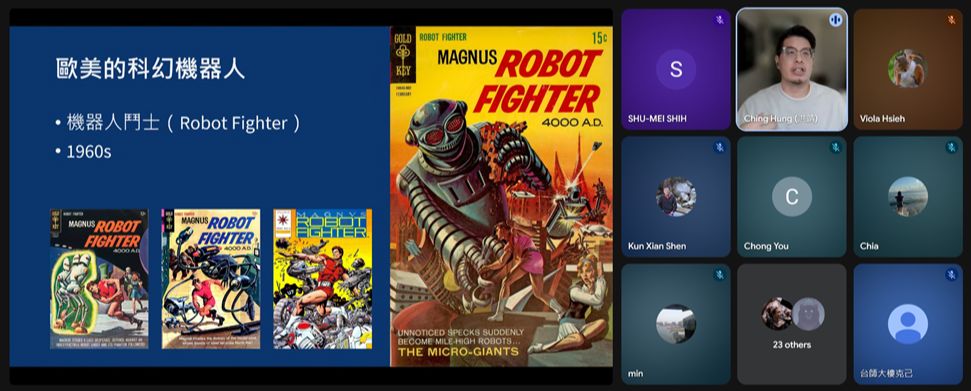
Assistant Professor Hung Ching then delivered a presentation examining the depictions of robots in American, Japanese, and Taiwanese science fiction comics. He noted that robots in Taiwan’s comics, while playful and superficially similar to their American and Japanese counterparts, are functionally educational, teaching readers about scientific concepts and morals, rather than imagining possible futures. Professor Hung argued that this reflects the educational role that science fiction plays in Taiwan’s culture, and also reflects a philosophy of science, which sees science only as a utilitarian means to an end.
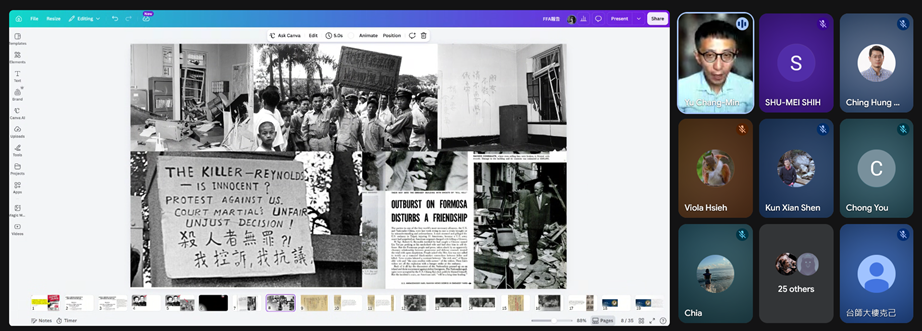
Finally, Associate Professor Yu Chang-min examined how the KMT attempted to insert its political narratives and culture into 1950s American media in order to sway public opinion, in a reversal of usual Cold War directions of cultural flow. The killing of a local Taiwanese by an American soldier in 1957 and the resulting uproar prompted the KMT to reconsider its diplomatic approach to the US. By hiring the Hamilton Wright Organization (HMO), an international media agency, they cultivated long-term relationships with American media news editors, and provided curated news, films, and stories for the American press, aiming to gradually and secretly alter the opinion of the American public and politicians.
The three lectures and final workshop prompted reflection and discussion from many listeners, and demonstrated the great potential for further work to be done in Taiwan Studies, as well as the strength of Sinophone studies as a theoretical basis. We look forward to hosting Professor Shih’s next lecture series and seeing the further contributions Sinophone studies will make to the field of Taiwan Studies.
This event was sponsored by the Yushan Scholar Program of the Ministry of Education.
Reporting by Gregory Laslo (樓克己)