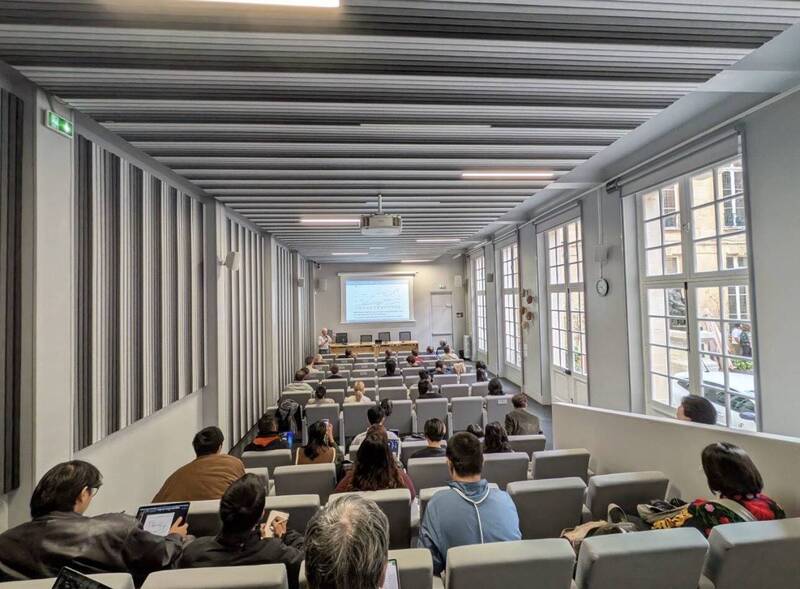

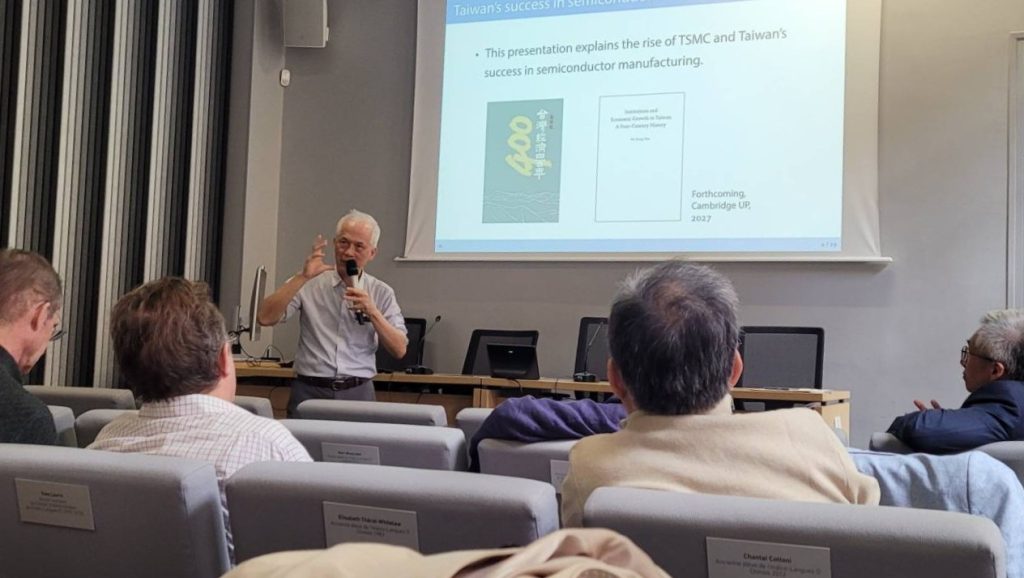
Beyond Taiwan’s experience in semiconductors, what can the world learn from Taiwan’s economic history? In October, National Taiwan University economists and ITSC members Wu Tsong-min (吳聰敏) and Elliot Fan (樊家忠) traveled to Paris to take part in a lecture series, exchanging ideas with French academics and industry figures on industrial development, institutional transformation, and women’s roles in the workforce. The atmosphere was lively, with attendees showing great interest in the history of Taiwan’s economic development, and the factors that spurred its transformation and growth, actively exploring the historical and institutional context that created the “economic miracle of Taiwan.”
The International Taiwan Studies Center at NTNU and the Taiwan Studies Center at Institut National des Langues et Civilisations Orientales (INALCO) co-organized the lecture series on Taiwan’s economy. Promoted by NTNU Professor and ITSC Director Nikky Lin (林巾力) and INALCO Chair in Taiwan Studies Professor Liu Chan-yueh (劉展岳), the event drew more than fifty scholars, students, and industry professionals.
NTU Professor Emeritus of Economics Wu Tsong-min used the rise of TSMC as his starting point to explore whether Taiwan’s success in semiconductor manufacturing was the result of careful government planning or simple happenstance. He pointed out that Taiwan’s electronics industry began to develop in the 1960s when companies took advantage of Taiwan’s low-cost, high-productivity workforce and favorable foreign investment environment and began setting up plants to assemble products in Taiwan. He also noted that an understanding of the infrastructure and workforce established and honed during the Japanese colonial era, as well as institutional reform promoted by US aid officials, later became critical factors in the success of the semiconductor industry.

NTU Distinguished Professor Elliot Fan shifted the focus to the experience of women. He pointed out that women in Taiwan have long had greater participation in politics, better economic prospects, and higher social status compared to those in Japan and Korea, and the gender pay gap is even lower in Taiwan than in the US. Furthermore, Taiwan has been a consistent leader in Asia in promoting gender-neutral laws and policies. Why is this the case in Taiwan? Professor Fan pointed to the Japanese-era sugar industry, the wave of postwar immigrants from China, the “guaranteed women’s quota” system in elections for public office, and the success of small- and medium-sized enterprises to explain how women in Taiwan have achieved such status.
Listen to Professor Wu and Professor Fan discuss their research in the new season of the ITSC Podcast.
Reporting by Director Nikky Lin (林巾力)