

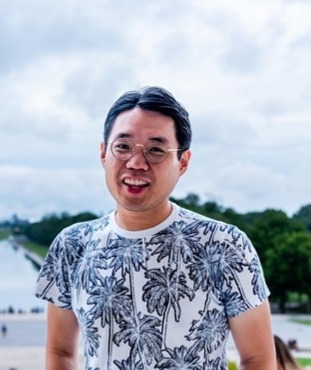
Sanho Chung (鍾燊豪) is an assistant professor at National Cheng Kung University’s Department of Political Science. In our interview, he shares his experience researching clientelism (侍從主義) in Taiwan’s local elections, and explains how, as a Hongkonger, his approach differs from established local methodologies, and what this brings to the field.
SC: Sanho Chung
JY: Jessica Siu-yin Yeung
JY: Could you please introduce yourself and your research?
SC: I’m a Hongkonger, born and raised in Hong Kong. I did my undergraduate studies at Hong Kong Baptist University, then my Master’s degree in Australia and my doctoral degree in the US. I found out during the second week of my study at the Australian National University that my prime research interest does not lie in International Relations, but in something more tangible, human-related, and place-based, such as Taiwan’s land politics (土地政治), which gives me a chance to get in touch with, observe, and interview people.
Clientelism, put simply, refers to the practice of vote-buying (買票). In Hong Kong slang, it’s called se zaai beng zung (蛇齋餅糭). I have always been interested in this phenomenon—for instance, I would wonder why an old lady would cast her vote for someone just because the political candidate offers her a bag of rice or a bottle of soy sauce. I did not see anyone, at least in Hong Kong, studying this practice from an academic perspective. My doctoral dissertation topic originally focused on Hong Kong, but because the practice of vote-buying declined in Hong Kong over the course of my doctoral study, I turned to examining cases from Taiwan to complete my dissertation. Here, there are many examples across many parties, including both the Kuomintang (KMT) and Democratic Progressive Party (DPP), that show that clientelism is alive and well in local elections in Taiwan.
JY: Can you elaborate on what you mean by “local?”
SC: When it comes to the study of elections, researchers often study them on a national scale. But I’m more interested in county magistrates (縣長), city mayors (市長), and village chiefs (村長). In other words, I study non-central elections (非中央選舉) because I am especially curious about whether voters evaluate political candidates in local and national elections by different standards. I am also interested in whether, at the local scale, voters judge the candidates in lower- and higher-level elections differently.
JY: Is this research considered niche in Taiwan?
SC: Studies on local factions (地方派系) in Taiwan are not uncommon, but my research departs from these existing studies by acknowledging the fact that local factions do not single-handedly determine the outcome of local elections. For instance, in clientelism, we have a supply-and-demand model. Local factions want to purchase votes (demand), and voters supply those votes (supply), in exchange for benefits such as material goods.
JY: If these exchanges are done under the table, how can you rely on surveys to get accurate data?
SC: In political science, we use both quantitative and qualitative methods, and we have well-established theories and assumptions to offset bias. For instance, online surveys skew towards young people and highly educated interviewees, and we can add a note at the end of the article manuscript to acknowledge this bias.
There is also a concept called social desirability (社會期許). For example, if you were asked whether you would litter on the street, you would say you wouldn’t, because we all know it is wrong. While social desirability bias is always an issue, we have developed some tools to mitigate its impact on survey outcomes. For example, there are some indirect ways to ask whether interviewees have done something or what their true feelings are towards something or someone, including list experiments, proxies for controversial issues, and so on.
The “science,” in political science refers to the probability of replicating the result. We actually have a higher probability of replicating a model than in medical science.
JY: How do you carry out these surveys?
SC: In both Taiwan and Hong Kong, we have polling firms do them for us. In Taiwan, these are better developed, but collecting data in Hong Kong has become somewhat difficult now. Besides commercial polling firms, Taiwan also has several university-based research institutes conducting academic surveys, elevating the field through rigorous methodological norms and enhanced disciplinary credibility.
If we do not use existing data, our collected data becomes dependent on our funding, as we need to design interview questions for the firms to run the surveys. I would say that now is a good time to study clientelism in Taiwan, as there are many interesting topics to pursue.
JY: In the humanities, it takes two to three years to publish an article, but the political climate changes every day. Is research results becoming outdated a concern?
SC: We try to present theories that will stand the test of time with our case studies. This is the most valuable kind of research. But of course, the validity of some data can be affected by socioeconomic changes, and for those data, it is undesirable to sit on them for so long that they become dated.
JY: What other projects are you working on at the moment?
SC: My other projects are also poll-related. One is related to satisfaction with the president—I want to know why voters use different criteria to evaluate politicians from the KMT and the DPP, and how those criteria differ. I also have other projects on political partisanship (政黨傾向) and the influence of political information on voters.
JY: As a foreigner, how is your research experience different from that of Taiwanese researchers?
SC: I would say I don’t have the burdens that come with hierarchy embedded in local institutions and can evaluate research from a more critical angle. Another advantage expats have in studying Taiwanese topics is that they can view the cases on their own terms. For instance, when studying local factions, I am not confined by the received wisdom of those who grew up in Taiwan, and can consider cases from different angles. I can make use of data collected by Taiwanese researchers in their published works, but contribute original theories useful to political scientists and journalists from, say, the US.
JY: Lastly, what advice would you like to share with other researchers doing Taiwan Studies?
SC: The first piece of advice is not to underestimate the capacity of Taiwan to produce interesting research. This especially holds true for me as a political scientist.
The second piece of advice is to position Taiwanese cases within a broader, more international framework to highlight their significance. I think this is good advice for social scientists in general.